The MAGIC-AVALON campaign
In the summer of 2025, three major European satellites have been launched: MTG-S on July 1st, MicroCarb on July 25th and Metop-SG-A1 on August 12th. Several instruments aiming at the observation of atmospheric composition and related surface emissions can be found of these platforms, such as IASI-NG and IRS infrared sounders, Sentinel-4 and 5 or 3MI. The calibration/validation phases of all these missions are planned to last until the end of June/July 2026.
An ambitious field campaign has been planned by a European consortium (France, Belgium, Germany and United Kingdom) to participate to the validation exercises of these missions, prepare the next generation of atmospheric space missions and address key scientific questions on anthropogenic greenhouse gases: the MAGIC-AVALON (Aircraft VALidation Of New-generation satellites) campaign.
Over the full month of June 2026, an international consortium of about 90 scientists will operate a battery of instruments deployed on the ground, onboard hundreds of weather balloons, as well as onboard three research aircrafts. Measurements will take place over France and Belgium.
The campaign is lead by CNRS-LMD and supported by three European Space agencies: CNES (Centre National d’Etudes Spatiales), ESA (European Space Agency) and EUMETSAT (European Organisation for the Exploitation of Meteorological Satellites).
Scientific objectives
The MAGIC-AVALON campaign aims at providing an extensive knowledge of the state of the atmosphere and the surface at the overpassing time of the satellites in order to address three scientific objectives:
- SO1: To validate newly launched European satellites: Metop-SG-A1, MTG-S and Microcarb.
- SO2: To provide urgently needed data on anthropogenic greenhouse gases and related gases (CO2, CH4, N2O, CO, HN3) for quantifying anthropogenic emissions with a focus on agriculture and farming.
- SO3: To prepare future European space missions, such as ESA Earth Explorer missions.
To reach these objectives, main targets are the measurements of: temperature, H2O, O3, CO2, CH4, CO, N2O, NO2, NH3 and aerosols.
Campaign characteristics
The campaign is expected to take place between 1-28 June 2026. This time period corresponds to the end of the validation phase of most instruments onboard Metop-SG-A1 and MTG-S and provides good measurement conditions in Western Europe. Moreover, a specific flight condition implemented by EUMETSAT will cover the two first weeks of the campaign: the Metop-C/Metop-SG-A1 tandem flight, during which these two satellites will closely follow each other on the same orbit in order to cross-validate both of them.
Measurements will take place over most of France and North-West Belgium. The campaign will build on several French instrumented sites: two stations part of the AirCore-France network (Aire-sur-l’Adour CNES site and MDH-Reims site), Lannion CMS site of Météo-France and SIRTA at Ecole polytechnique. All of these stations will be used to daily launch weather ballons in order to measure atmospheric profiles of temperature, humidity, atmospheric gases and aerosols. They will also host several ground-based instruments that will continuously measure various atmospheric and surface variables. Research aircrafts will be deployed to fly over satellite tracks, linking all sites together.
In addition, two specific regions will be extensively monitored: Flanders (Belgium) and Brittany (France). These two regions are strong emitters of methane and amonia, as well as carbon dioxide. They will be used to evaluate the capability of current and future space missions to capture these anthropogenic emissions.
The instruments
About 40 instruments will be deployed during MAGIC-AVALON:
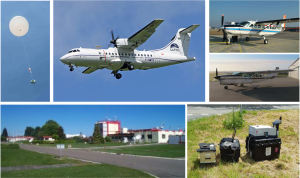
- 120 weather balloons should be launched from the 4 identified stations described above. They will carry: AirCore atmospheric sampler, weather radiosondes, ozone sondes and particule counters.
- Three research aircrafts are joining the campaign for more than 200 hours of scientific flight: SAFIRE ATR42, DLR Cessna-Caravan and BSF-Swissphoto Cessna-Caravan. Payload will include remote sensing instruments, such as OSIRIS (3MI demonstrator), SCALE (CNES CO2 lidar) or Telops HyperCam, as well as atmospheric samplers such as SPIRIT, or the new IAGOS bay. Coordinated flights are organized to take advantage of the full suite of instruments onboard the planes.
- Ground-based measurements will include: mobile Fourrier Transform Spectrometers operating in the infrared (from the far-infrared, such as FINESSE, to the shortwave-infrared, such as CHRIS), aerosol lidar and photometer, and several lidars measuring gas abundances (H2O, CO2, CH4), wind and temperature.
The team
All together, the campaign involves 10 teams from 5 countries:
- LMD (CNRS, Ecole polytechnique, Sorbonne Université, ENS – France) – lead
- AERIS (CNRS – France)
- AEROLAB/CIEL (CNRS, Université de Reims-Champagne Ardennes – France)
- BIRA-IASB (Belgium)
- CMS (Météo-France – France)
- CNRM (CNRS, Météo-France – France)
- CNES (France)
- DLR (Germany)
- Imperial College (UK)
- LAERO (CNRS, Université de Toulouse – France)
- LOA (CNRS, Université de Lille – France)
- LPC2E (CNRS, Université d’Orléans – France)
- LSCE (CNRS, CEA, Université de Paris-Saclay – France)
- ULB (Belgium)
- SAFIRE (CNRS, Météo-France, CNES – France)
Campaign logbook
Campaign preparation is on-going…
Link to campaign website
https://observations.ipsl.fr/aeris/avalon/#/map
Ackowledgments
The MAGIC-AVALON campaign is funded by CNES through its annual research program (APR, project IASI-NG), by ESA throught the MAGIC-POEM project and by EUMETSAT.